COMPARISON
Kouper vs DeskMD — When Care Navigation Is Overkill for a Fee-for-Service Practice
Kouper emerged from stealth in May 2025 with $10 million in funding from General Catalyst, CVS Health Ventures, and 25Madison. The team came out of Komodo Health and GetSnooze. The product — an enterprise AI care-navigation platform — is genuinely impressive. It just isn’t built for most solo practices.
If you’re a fee-for-service solo or small practice researching Kouper after seeing it at a conference, here’s the honest read: their value proposition assumes you bear financial risk for patient outcomes. If you don’t, you’re paying for capabilities you can’t use.
What Kouper actually does
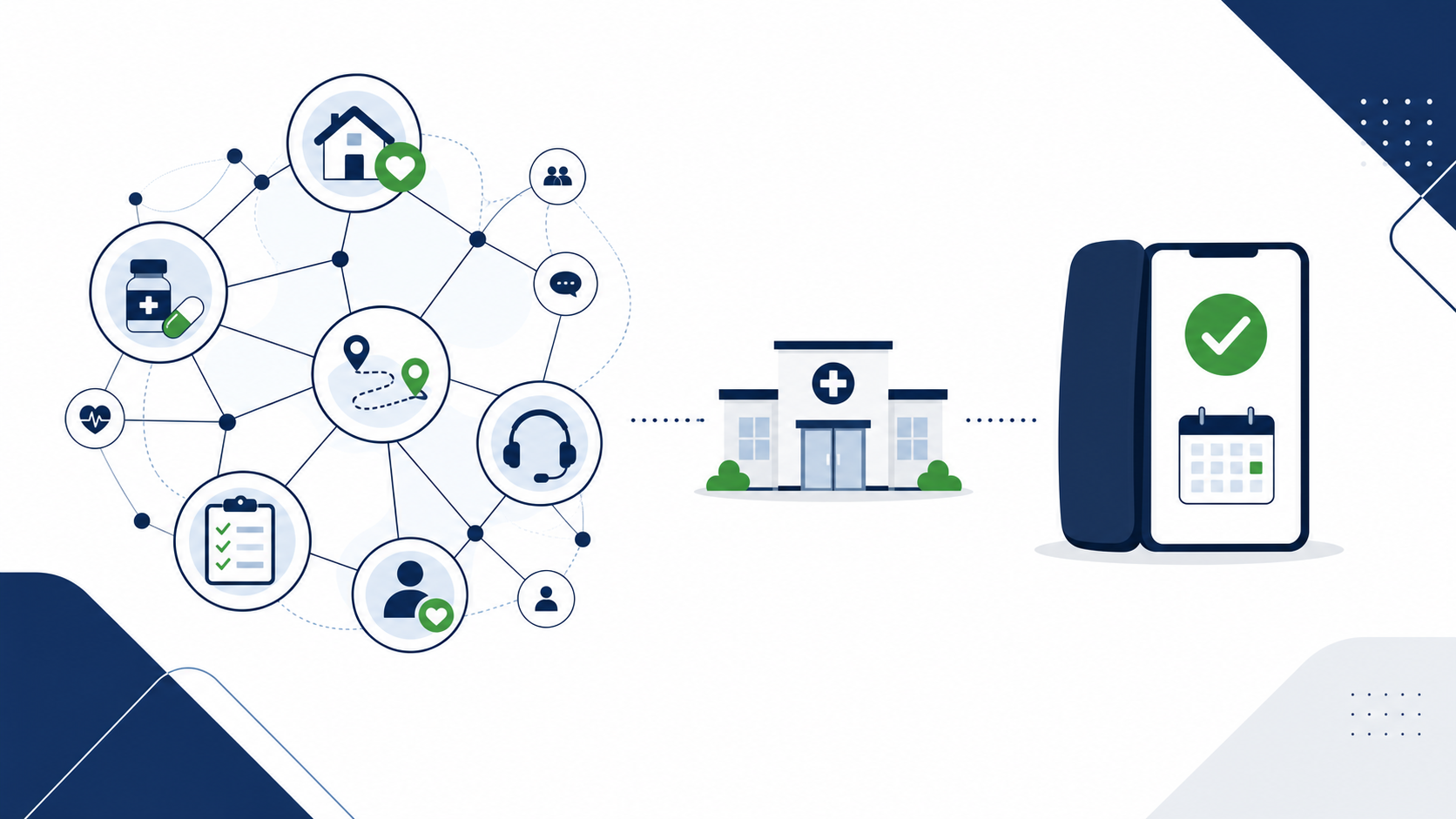
Kouper is built for organizations managing patient panels across the full continuum of care. Their voice and SMS agents handle:
- Post-discharge follow-ups with medication confirmation
- Care management check-ins for chronic conditions (diabetes, hypertension, behavioral health, maternal care)
- Risk stratification — identifying which patients need intervention based on clinical data
- Medication adherence outreach
- SDOH screenings (social determinants of health)
- Transportation coordination
- Transitions of care — the hand-off from hospital to outpatient
- Standard inbound answering: scheduling, billing, refills, FAQs
The platform reads ADT feeds (admission, discharge, transfer notifications from hospital EHRs), clinical notes, schedules, and care plans. That last part is important — Kouper isn’t just listening to the phone. It’s wired into hospital-grade data feeds so it knows when a patient is discharged and can call them automatically two days later to confirm they filled their prescription.
Their published verticals: ENT, urgent care, FQHC, cardiology, oncology, primary care, orthopedics, behavioral health.
Who Kouper is built for
The economics of care navigation only make sense when there’s a financial incentive to close care gaps. That maps to:
- FQHCs and community health centers with HRSA quality measures
- ACOs and risk-bearing primary care groups (capitated, Medicare Shared Savings, MA panels)
- Health systems with readmission penalties under HRRP
- Specialty groups embedded in value-based-care contracts where post-discharge follow-up is the difference between getting paid and not
- Multi-specialty groups with 20+ providers and a population health team
If you bear risk on patient outcomes — meaning you get paid more or less depending on whether your patients fill their prescriptions, show up to follow-ups, and avoid the ER — Kouper’s capabilities directly map to revenue. Closing one HEDIS gap can be worth $50–$500. Preventing one 30-day readmission can be worth thousands.
Who Kouper is not built for
If you’re a fee-for-service solo or small practice — meaning you bill per visit, per procedure, per code, and your revenue isn’t tied to patient outcomes — Kouper’s capabilities don’t translate into ROI for you.
You don’t get paid extra for confirming a patient’s medication adherence. You don’t get penalized for a 30-day readmission. Closing an HEDIS measure on a patient doesn’t increase your reimbursement. Kouper is solving a financial problem you don’t have.
What you do have, almost certainly, is a phone problem: missed calls, voicemail backlog, after-hours coverage gaps, patients who can’t reach a human when they call at 4 p.m. on a Friday. Kouper can technically answer the phone — but you’re paying enterprise prices for the half of the product that’s not actually the differentiator.
The price gap
Kouper doesn’t publish pricing. Enterprise AI platforms backed by CVS Health Ventures and General Catalyst typically charge:
- Platform fee starting at $10,000–$100,000+ per year
- PMPM (per member per month) for risk-bearing engagements: typically $0.50–$5.00 per attributed patient per month
- EHR integration and implementation fees
- Annual contracts with minimum commitments
For a primary care panel of 1,500 patients at $2 PMPM, that’s $3,000/month just on the per-patient component, before platform fees. Compare to DeskMD at $299/month flat per provider for the front-office answering piece, which is most of what a fee-for-service solo practice actually needs.
What a fee-for-service solo practice typically needs instead
If care navigation is overkill, what’s the right shape of tool? Five things, in order of pain:
- Answer every call, 24/7, with structured intake — not voicemail
- Route correctly — caller asking for Dr. Smith lands in Dr. Smith’s inbox, not a shared bucket
- Escalate emergencies — symptoms suggesting an emergency get human callback within minutes
- Multilingual if your patient population needs it
- Reasonable cost — under $500/month for a solo practitioner
That’s the DeskMD scope. Not care navigation. Not population health. Just answering the phone well, in a way that lands a usable record in your inbox.
DeskMD vs Kouper — side by side
| DeskMD | Kouper | |
|---|---|---|
| Category | AI front-office answering | AI care navigation platform |
| Pricing | $299–$449/provider/month, published | Enterprise contract, not published; likely PMPM |
| Minimum commitment | Month-to-month | Annual contract typical |
| Smallest realistic customer | Solo practitioner | FQHC, multi-specialty group, health system |
| Inbound calls | Yes (core) | Yes |
| Outbound calls | No | Yes (their core) |
| SMS | No | Yes |
| Post-discharge follow-up | No | Yes (ADT-feed triggered) |
| Medication adherence outreach | No | Yes |
| SDOH screening | No | Yes |
| HEDIS measure closure | No | Yes |
| Best for | Fee-for-service solo and small practices | Risk-bearing groups, FQHCs, health systems |
The honest case for Kouper
Pick Kouper if any of the following are true:
- You’re part of an ACO, MSSP, MA panel, or other risk-bearing arrangement where HEDIS measures or readmission rates affect your revenue
- You’re an FQHC with HRSA quality reporting requirements
- You have a population health team and need them more leverage
- Post-discharge follow-ups, medication adherence, and SDOH screening are recognized priorities in your organization
- You have 20+ providers and the budget to support an enterprise platform
For these customers, Kouper’s PMPM math works because closing one care gap pays for many months of the platform.
The honest case for DeskMD
Pick DeskMD if:
- You’re a solo or small (1–10 provider) fee-for-service medical practice
- You bill per visit, per procedure, per code — not capitated or value-based
- Your real pain is missed phone calls, not unclosed care gaps
- You want a predictable monthly cost under $500 per provider
- You don’t want a sales cycle, an annual contract, or an implementation team
Bottom line
Kouper is a strong platform for the customers it’s built for. If you’re a risk-bearing organization with HEDIS measures, readmission penalties, or a population health mandate, they’re worth the demo. If you’re a fee-for-service solo practitioner who just wants to stop missing phone calls, Kouper is the wrong tool — not because it’s bad, but because you’re paying for the half of the product that doesn’t apply to you.
The right tool for fee-for-service solo practices is the simpler one. That’s DeskMD’s lane.